Is Your Brand on the Wrong Platform? 2025 Data on Dominance, Engagement and Winning Strategies

By analyzing over 980,000 branded content pieces from the Hyperiser ecosystem, we take a closer look at the influencer dynamics of 2025 and the brands driving market concentration.
The Platform Equation: Volume or Engagement?
Based on data from the Hyperiser ecosystem and the analysis of more than 980,000 branded content pieces, we examine the key influencer dynamics of 2025 and the brands shaping the competitive landscape.
Platform selection is no longer a matter of preference, but a strategic decision aligned with campaign objectives. The data reveals three distinct ecosystems:
- Instagram: Hosting 93% of all branded content, it maintains its position as the primary platform. However, success here is driven not by one-off posts, but by consistency and always-on presence.
- TikTok: With a 3.72% engagement rate, it has become the new favorite for performance-driven campaigns. Moreover, with #işbirliği (#collab) used in 72% of branded posts, it stands out as the platform with the highest level of transparency.
- YouTube: Although only 8% of content is directly labeled as ‘collaboration,’ in-video integrations and sponsorships continue to make it the leading platform for building editorial trust.
Power Consolidation on Instagram: 50% Share Dominated by Just Three Brands
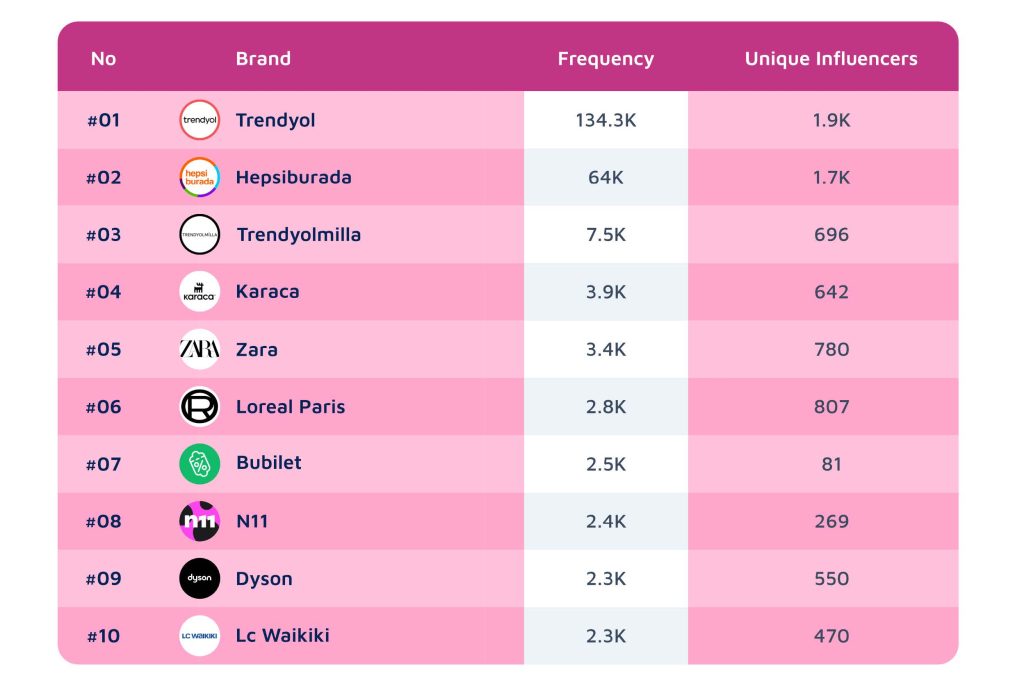
Behind Instagram’s massive content volume lies a highly concentrated competitive landscape. The data demonstrates how market leadership is constructed: Trendyol, Hepsiburada and Trendyolmilla account for nearly half of all collaboration-based content in 2025.
These brands represent the strongest adopters of the .com sector’s “always-on” strategy, producing an average of 63 content pieces per influencer. For them, Instagram is not merely an advertising channel—it operates as a continuously active sales engine.
Here are the leading advertisers of 2025:
Sectoral Approaches: Frequency vs. Diversification
For other market players, two primary strategies stand out:
- .com Sector: “Fewer influencers, very high frequency.”
A loyalty- and performance-driven model focused on repetition and sustained visibility. - FMCG & Fashion: “Large influencer pool, lower frequency.”
A model centered on audience diversification and unique reach. The critical factor here is accurately analyzing whether different influencers are reaching the same audience (audience overlap).
The #Collaboration Landscape: Regulation and Transparency
Labeling practices are increasingly moving toward standardization, although gray areas still remain. The most common combination — #işbirliği + #reklam — (#collab + #ad) demonstrates growing regulatory awareness among both creators and brands.
Meanwhile, the prominence of #pr, #gifted, and #invited tags on Instagram and TikTok indicates that experience-driven communication continues to be a strong strategic approach.
In Conclusion
The 2025 data clearly shows that:
- Scaling on Instagram requires sustainable frequency.
- Standing out on TikTok demands engagement-driven authenticity.
- Establishing presence on YouTube depends on well-framed commercial messaging.
What unites the market leaders controlling half of the ecosystem is simple: consistency.
This data has been compiled from the Hyperiser Universe 2025 Report. Visit Hyperiser now to access the full report.